


Key takeaways
- Frontline disruption is no longer occasional. It’s the daily baseline, and managers are absorbing it with workarounds leadership can’t see.
- More workforce data isn’t the answer if it’s raw, partial, or out of reach when a decision has to be made.
- AI layered on disconnected workflows doesn’t fix them. It inherits the gaps and makes them more visible.
- Frontline AI readiness starts with the problem, the people closest to the work, and an honest look at your foundation, not with the technology.
- The best place to start is the one process where fragmentation costs the most and the cost is measurable.
Every organization with a frontline workforce is being asked the same question right now: What’s our AI strategy? It’s a fair question. But a recent Dayforce panel made a case worth hearing before anyone answers it: AI won’t fix disconnected frontline workflows. It will expose them.
That was the title of the session OnActuate joined at Dayforce’s AI Virtual Summit. Marnie Larson, OnActuate’s Senior VP of Sales, Marketing & HCM for the Americas, sat down with Dayforce’s Andrew Garcia (VP of Product) and Lauris Apse to unpack new Dayforce research on frontline operations and what it means for organizations looking to AI. The conversation kept coming back to one idea: frontline AI readiness has much less to do with AI than most people expect.
Here are the takeaways we think matter most, whether you’ve run Dayforce for years or you’re still evaluating it.
Why does frontline transformation struggle to stick?
Because disruption has become the baseline, and most organizations are still running on systems and habits built for the occasional disruption. Marnie has worked in HCM, payroll, and time and attendance for more than 30 years. She described it this way: a weather day or flu season used to be the exception. Now variability is constant.
The research shows what that looks like. Nearly three-quarters of frontline workers rely on manual workarounds to handle everyday disruptions, and 90% have had to find their own way to cover an open shift. Meanwhile, the share of frontline workers who feel their leaders understand their challenges fell from 62% to 42% in just two years.
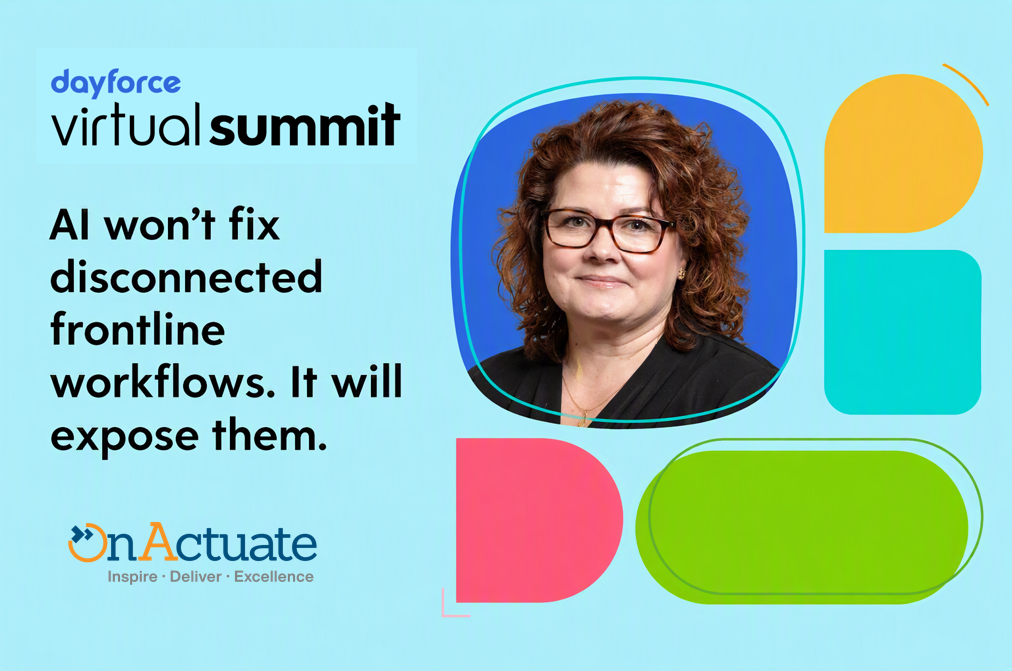
Watch the full Dayforce Virtual Summit session on-demand, AI won’t fix disconnected frontline workflows. It will expose them.
As Marnie put it, that drop doesn’t mean leaders stopped caring. It means the work holding operations together has slipped out of sight:
“On paper everything looks fine – shifts are covered, targets are met. But it’s being held together by people, in real time, and none of that effort shows up anywhere leadership can see it.”
— Marnie Larson, OnActuate
That’s why new initiatives fade. Eighty percent of executives and managers in the research said daily operations pull focus from transformation or keep it from sticking, and only 6% said transformation is well integrated into daily work. The organization is too busy holding itself together to change.
If we have the data, why don’t we have the full picture?
Because having data isn’t the same as having usable insight at the moment of decision. Sixty-seven percent of executives and managers say decisions slow down at least sometimes because workforce data isn’t in one place. More than half of frontline workers and managers are still re-entering or reconciling data across systems by hand.
Lauris described three ways this usually breaks down:
- It’s raw. You have numbers, but not the insight that leads to a better decision.
- It’s partial. Payroll, scheduling, and training or certification data often live in separate places and never come together.
- It’s out of reach. Even when the full picture exists, it sits in a report or dashboard a manager can’t get to in the moment, so it doesn’t get used.

OnActuate’s complimentary HCM Optimization Assessment helps organizations identify areas where technology, processes, and workforce operations can be optimized to better support HR teams and managers.
Why will AI expose disconnected workflows instead of fixing them?
Because AI inherits whatever foundation it sits on. If scheduling, time, pay, and skills are disconnected, and people are bridging the gaps by hand, AI doesn’t remove those gaps. It works on top of them.
The research suggests many organizations haven’t looked at this closely yet. Only 29% of executives and managers say they’ve meaningfully evaluated AI for frontline work, and 78% of frontline managers say their systems at least sometimes fail to give clear guidance when operational issues come up.
When Andrew asked whether layering AI over a fragmented environment just makes a broken process move faster, Lauris said that would be the best case. The bigger risk is spending money on something that doesn’t work, frustrating employees, and losing credibility for the next initiative. People were promised something better and got the same process with a new interface.
“If scheduling, time, pay, and skills all sit in separate systems and someone is manually reconciling them, AI won’t fix that — it’ll inherit it.”
— Marnie Larson, OnActuate
What does frontline AI readiness actually mean?
Frontline AI readiness means understanding where your work breaks down, involving the people who live with it, and being honest about how connected your foundation really is, before choosing technology. You don’t need everything to be perfect. You do need clarity.
Marnie suggested three questions to ask first:
- Where does our work actually break down today, and do we understand why? In the research, 74% of leaders said many shift-level disruptions could be prevented with better real-time information. Start by finding where you’re flying blind, not where you can add AI.
- Is the frontline in the room? Readiness becomes an IT-only exercise the moment frontline managers are left out. They know where the workarounds live and where decisions are made on gut feel because the system can’t help.
- How connected is our foundation, really? Be candid about what’s integrated and what isn’t, before spending on the exciting part.
Lauris added a complementary lens: tie any AI effort to a specific problem and its value, work with a partner who has done it before, and invest in trust through transparency, since trust drives adoption and adoption drives value.

Want to explore the research behind these findings? Download Dayforce’s “Adaptability Meets Reality: How the Frontline Workforce Quietly Passed Its Breaking Point” report for additional insights into how organizations can strengthen frontline operations.
In the public sector, where OnActuate does much of its work, this step matters even more. Complex pay rules, collective agreements, and public accountability for every dollar spent leave little room for technology that has to be rolled back. The same principle applies in retail, healthcare, manufacturing, and any operation that runs on shifts.
What changes when people, pay, time, and skills work together?
The benefits show up in many places at once. When the research asked what connecting these areas could make possible, no single answer ran away with it. Productivity led, but consistency, responsiveness, decision confidence, and more time for managers to lead people were close behind.
Lauris’s advice was practical: decide up front how you’ll measure success, and be deliberate about reclaiming time. If manager time is freed up, plan for how it gets used so it doesn’t simply disappear.
For Marnie, the clearest sign of success is human. Nearly 90% of respondents said shift issues are affecting their well-being. (We explored this in more depth in why manager burnout is often an operations problem.) Get the foundation right and the manager’s day changes:
“The manager stops being the shock absorber. Put the people first, and let the system absorb the chaos instead of the person. It should feel like the job they were actually hired to do.”
— Marnie Larson, OnActuate
.
Where should organizations start?
Start where it hurts, and where you can measure it. Marnie closed the session with a three-step starting point:
- Pick one painful, measurable process. For many organizations, that’s shift coverage and overtime. In the research, overtime caused by coverage gaps was the single biggest driver of unplanned labor cost. The pain is real, the cost is countable, and you can prove value quickly.
- Map how that process really works, workarounds included. Not the flowchart on the wall. This is usually where the “aha” moment happens, often the same manual step repeated across four systems.
- Don’t do it alone. Your team knows your operation. A good partner knows the potholes. The technology usually isn’t the hard part; the change is.
Reclaim the Manager Layer Through Better Workforce Operations
Frontline complexity may be unavoidable.
But unnecessary complexity in the systems supporting frontline work does not have to be.
Organizations that invest in connected workforce processes can help managers move from constantly reacting to confidently leading.
By improving visibility, reducing manual workarounds, and supporting better decisions at the moment they happen, organizations can strengthen compliance, improve employee experiences, and create more resilient workforce operations.
Ready to identify where workforce complexity is impacting your organization?
OnActuate can help evaluate your current HCM environment, uncover optimization opportunities, and build a roadmap for more connected workforce operations.